Project Title
Investigation of stress states and elastic-plastic deformation mechanisms for polycrystalline grains using novel experimental methodologies and multiscale modeling
Project Director
Abstract
The macroscopic elastic-plastic properties of polycrystalline materials depend on chemical composition, microstructure, phase composition, crystal structure, and crystallographic texture. These characteristics directly affect mechanisms of plastic deformation at the mesoscale, i.e., the scale of polycrystalline grains. Developing experimental methodologies to study material behavior at this scale is therefore essential. Knowledge of plastic processes at the grain level is necessary to understand and describe macroscopic properties such as hardness, hardening, and elastic-plastic behavior.
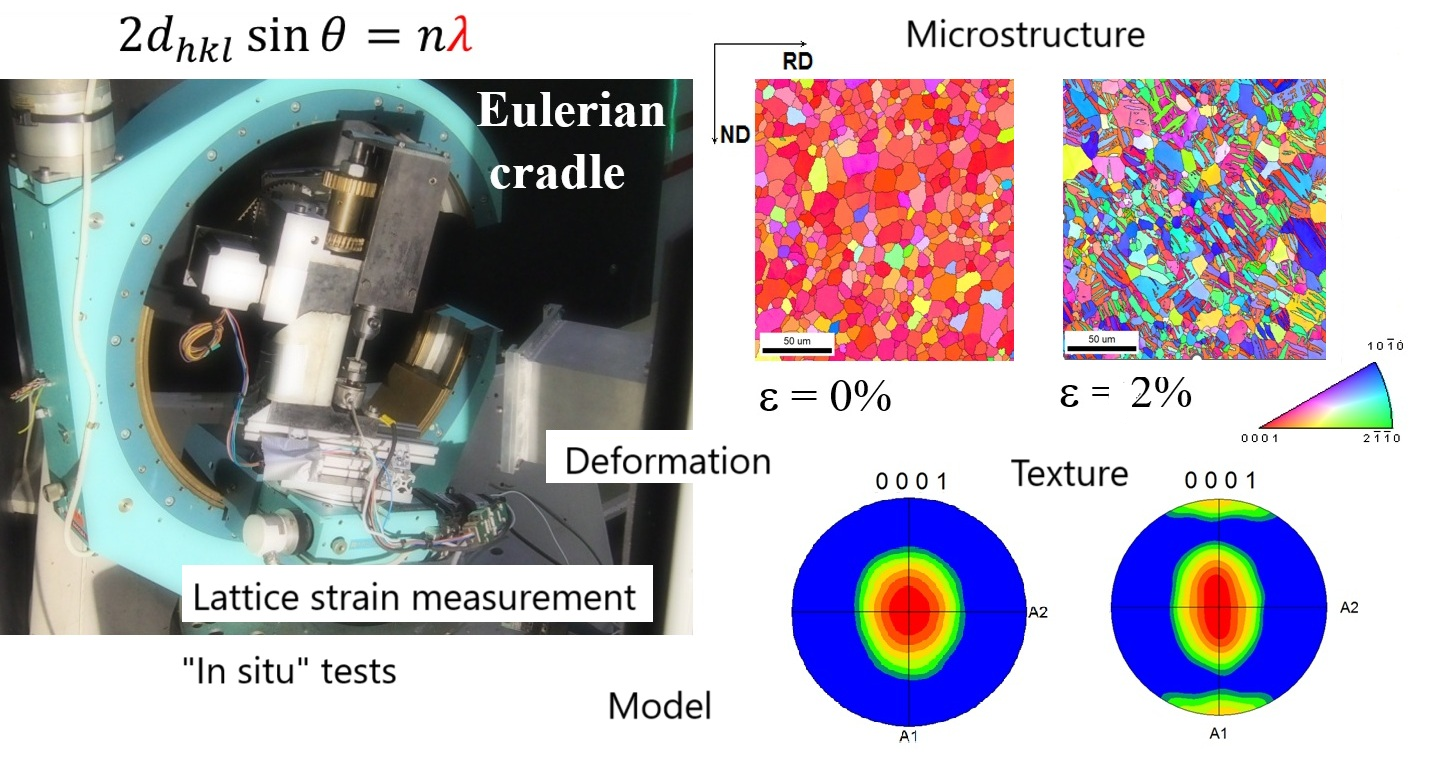
Special attention is paid to two-phase and composite materials, which are unique from the point of view of their mechanical properties, combining features of constituent phases. Investigating each phase is challenging; diffraction methods allow selective, non-destructive measurement of lattice strains and their evolution. The displacement of diffraction peaks provides detailed information about individual crystallites. Combining diffraction experiments with self-consistent modeling enables study of active slip systems, twinning, and stress evolution during deformation.
Elastoplastic deformation depends on grain-level phenomena such as slips, twinning, and detwinning. Determining critical resolved shear stresses (CRSS) for slip and twinning activation is crucial, as these processes are driven by localized stresses. Interactions between grains and crystallographic texture further influence overall mechanical behavior. Previously, stress localization was studied with elastoplastic models, but assumptions about intergranular interactions introduced uncertainties. Our methodologies allow direct experimental determination of stresses at the grain scale, including for two-phase materials and complex loading paths.
The main goal of this project is to advance and apply these original methodologies to study complex materials such as two-phase alloys and metal matrix composites, to validate elastoplastic self-consistent models, and to link phenomena across scales. This will allow prediction of complex elastic-plastic deformation for materials with varying crystallographic textures.
Publications
- A. Baczmański, S. Wroński, M. Francois, L. Le Joncour, B. Panicaud, C. Braham, A. Ludwik, K. Wierzbanowski, V. Klosek, Study of grain stresses and crystallographic slips in duplex steel using neutron diffraction, International Journal of Mechanical Sciences 283 (2024) 109745. DOI
- D. Byrska-Wójcik, M. Ostachowska, J. Gibek, K. Wierzbanowski, M. Wróbel, R. Błoniarz, A. Baczmański, M. Kopyściański, I. Kalemba-Rec, Effects of asymmetric rolling with tilted material entry on texture and mechanical properties of aluminium, Journal of Materials Processing Technology 338 (2025) 118796. DOI
- S. Nowak, M. Wroński, S. Wroński, A. Baczmański, C. Braham, M. Marciszko-Wiąckowska, Evolution of intergranular stresses in titanium studied using grazing incident X-ray diffraction and self-consistent model, Journal of Materials Research and Technology 36 (2025) 3528–3545. DOI
- M. Marciszko-Wiąckowska, A. Baczmański, D. Apel, M. Klaus, C. Genzel, M. Chemkhi, M. Saferna, K. Wierzbanowski, J. Kawałko, L. Le Joncour, M. Francois, P. Bała, Angle- and energy-dispersive diffraction used to determine stress evolution in 17-4 PH stainless steel produced by ADAM and subjected to SMAT processing, Journal of Applied Crystallography 58 (2025) 2049–2065. DOI
- W. Łatas, M. Wróbel, K. Wierzbanowski, D. Byrska-Wójcik, Interpretation of Copper Rolling Texture Components Development Based on Computer Modeling, Crystals 15(12) (2025) 1011. DOI
- A. Ludwik, M. Wroński, P. Kot, A. Baczmański, S. Wroński, K. Wierzbanowski, G. Farkas, K. Máthis, Crystallographic slips and twinning activity in AZ31 magnesium alloy during different modes of deformation, Journal of Magnesium and Alloys (2025). DOI
Conferences & Presentations
- XIII Neutron Scattering and Complementary Methods in Material Research, Chlewiska, Poland, June 9 - 13, 2024.
Conference website,
Book of Abstracts
- A. Baczmański, A. Ludwik, S. Wroński, K. Wierzbanowski, P. Kot, M. Wroński,
Measurement of lattice strains in two-phase materials under external load,
Abstract Book, p. 29 (oral)
- P. Kot, A. Baczmański, A. Ludwik, M. Wroński,
Study of plastic deformation mechanisms in textured magnesium AZ31 using neutron diffraction,
Abstract Book, p. 27 (oral)
- ICOTOM 20: 20th International Conference on Textures of Materials, Metz, France, June 30 - July 6, 2024.
Conference website,
Book of Abstracts
- A. Ludwik, P. Kot, A. Baczmański, M. Wroński, Ch. Scheffzük,
Crystallite group method for grain stress determination in textured materials using neutron diffraction,
p. 258 (poster)
- P. Kot, A. Baczmański, A. Ludwik, M. Wroński, S. Wroński, G. Farkas,
Neutron diffraction study of texture and stress evolution in magnesium AZ31 during cyclic loading,
p. 333 (oral)
- K. Wierzbanowski, D. Byrska-Wójcik, M. Wróbel,
Numerical study of texture evolution during asymmetric rolling using ABAQUS and two crystal models,
p. 68 (poster)
- M. Wroński, A. Baczmański, A. Ludwik,
Study of twinning behaviour in titanium under different loading paths,
p. 260 (oral)
- ECRS11: 11th European Conference on Residual Stresses, Prague, Czech Republic, June 3 - 7, 2024.
Conference website,
Conference Proceedings
- A. Baczmański, M. François, L. Le Joncour,
X-ray stress factors in diffraction stress analysis of sample interiors and surfaces,
keynote lecture
- S. Wroński, A. Baczmański, P. Kot,
Role of second-order plastic incompatibility stresses in magnesium,
poster
- A. Ludwik, A. Baczmański, M. Wroński,
Study of plastic deformation in two-phase CuZn39Pb3 alloy using neutron diffraction,
oral
- M. Saferna, A. Baczmański, K. Wierzbanowski,
High and conventional strain rate response of titanium under severe plastic deformation,
poster
- 20th Metal Forming International Conference (Metal Forming 2024), Krakow, Poland, September 15 - 18, 2024.
Conference website
- D. Byrska-Wójcik, K. Wierzbanowski, A. Baczmański,
Multi-scale modeling of multi-pass rolling texture using crystal plasticity and FEM,
oral
- 12th International Conference on Residual Stresses (ICRS 12), Detroit, MI, USA, October 20 - 23, 2025.
Conference website
- K. Wierzbanowski, D. Byrska-Wójcik, M. Ostachowska, M. Wróbel, R. Błoniarz, A. Baczmański,
Effect of asymmetric rolling on texture and plastic ductility of aluminum,
October 21, 2025 (poster)
- M. Marciszko-Wiąckowska, A. Baczmański, M. Chemkhi, M. Saferna, K. Wierzbanowski, J. Kawałko,
L. Le Joncour, M. François, D. Apel, M. Klaus, C. Genzel, P. Bała,
Investigation of Residual Stress and Elastic Anisotropy in 17-4 PH Stainless Steel Manufactured via Atomic Diffusion Additive Manufacturing and Treated with Surface Mechanical Attrition,
October 21, 2025 (oral, spotlight)
- A. Baczmański, A. Ludwik, P. Kot, G. Garcés, G. Bruno,
Stresses and Micromechanical Properties of Textured Magnesium Alloy Analyzed Using Low- and High-Energy X-Ray Diffraction Methods,
October 22, 2025 (oral)
- A. Ludwik, P. Kot, A. Baczmański, M. Wroński, S. Wroński, G. Farkas, K. Máthis, K. Wierzbanowski,
Influence of grain stresses on the mechanical behavior of textured AZ31 magnesium alloy studied using neutron diffraction,
October 21, 2025 (poster)
- XVIII International Conference on Computational Plasticity. Fundamentals and Applications (COMPLAS 2025), Barcelona, Spain, September 2 - 5, 2025.
Conference programme
- K. Wierzbanowski, D. Byrska-Wójcik, M. Ostachowska, R. Błoniarz, M. Wróbel, A. Baczmański,
Texture and Mechanical Parameters Modifications During Asymmetric Rolling, (oral)
- A. Baczmański, A. Ludwik, P. Kot, S. Wroński, M. Wroński, K. Wierzbanowski, G. Farkas,
Plastic Deformation of Magnesium Alloy – Modelling Based on Neutron Diffraction Measurements, (oral)